Posted in Uncategorized

Fate. Or phate?

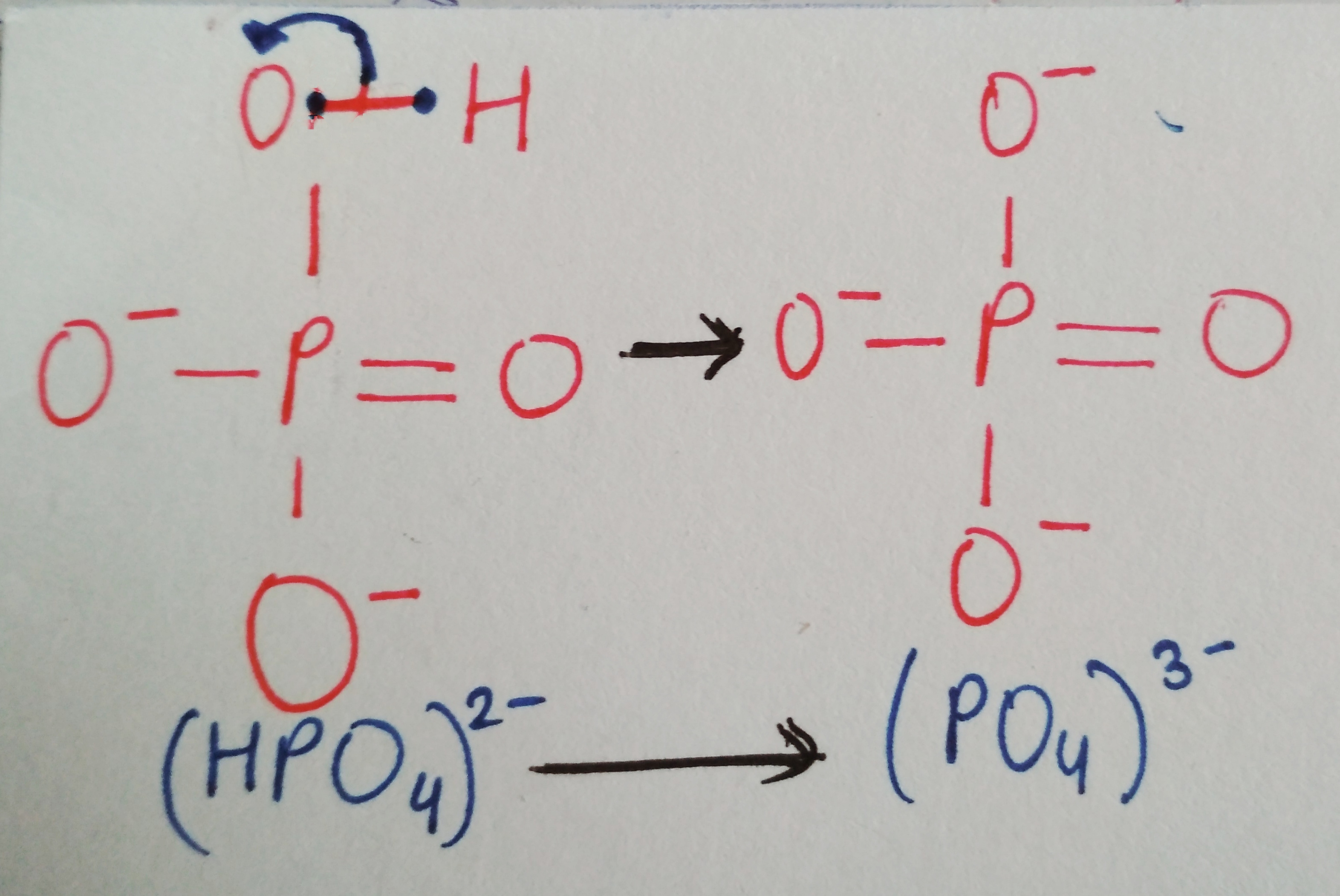
We are not getting philosophical today. In the world of biology, PHOSPHATE happens to be a crucial ion, considering that it plays such an important role in providing our cells with energy. it is also a part of nucleic acids, forming the “Sugar-Phosphate Backbone”. it is because of the phosphate group that DNA and RNA are termed as “Acids”, despite the presence of Nitrogenous “Bases” in them. a typical DNA and RNA has Hydrogenphosphate (HPO4)2-, but in aqueous medium, the H+ dissociates immediately, making it acidic in nature.
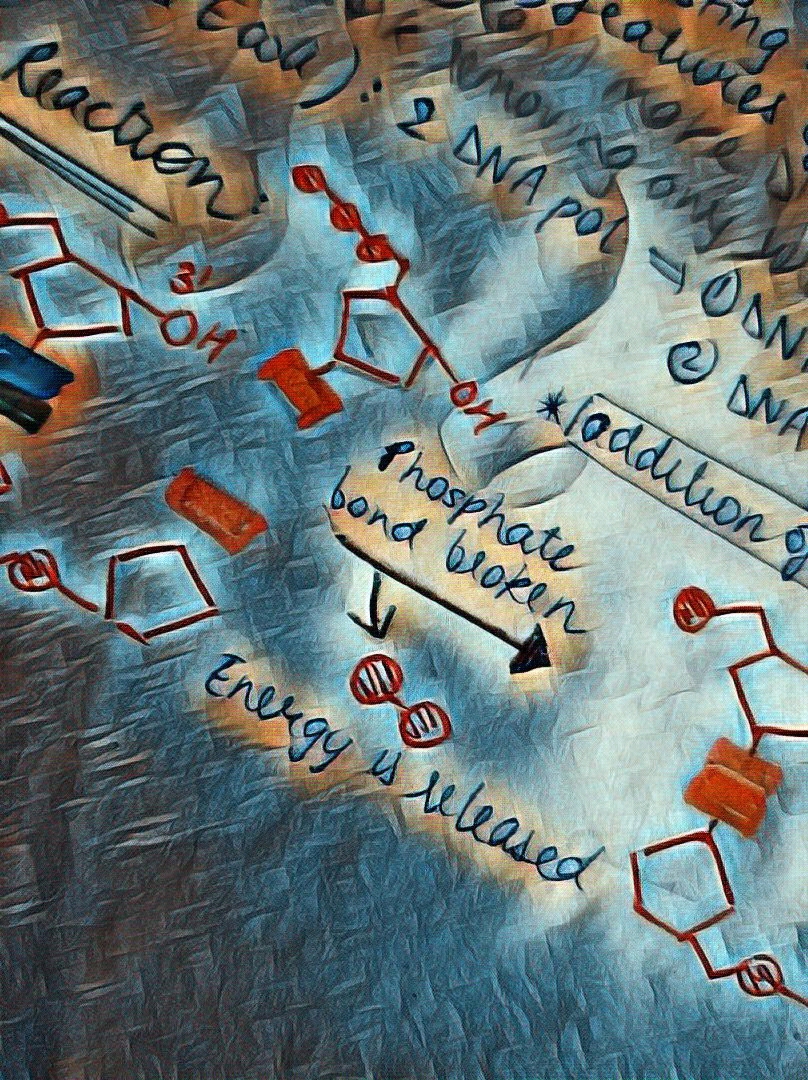
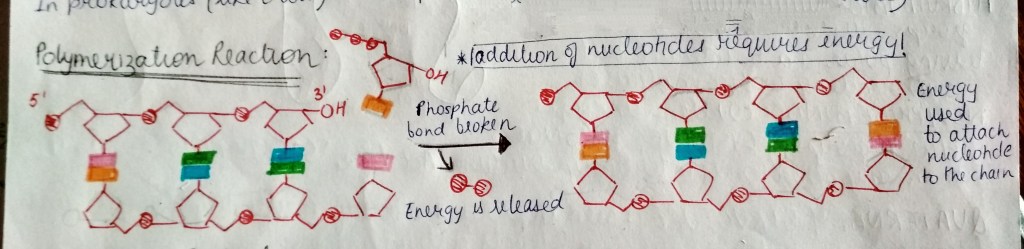
in a cell, a nucleotide is actually present with 3 phosphate groups attached to it. when a particular nucleotide is about to become a part of a growing DNA/RNA, it loses 2 of its phosphate groups, releasing energy. this energy is used in addition of nucleotides to the DNA/RNA chain. (image of nucleotide attaching and energy)
Posted in Uncategorized

Sugars! (dieters can still read)

Oh that dreadful word! Sugar! Sweet, addictive, secretly makes that tummy become chubby. But two out of the numerous sugars we know of help make us who we are! That’s right. DNA and RNA have sugars in them, which make up the very backbone of these molecules.

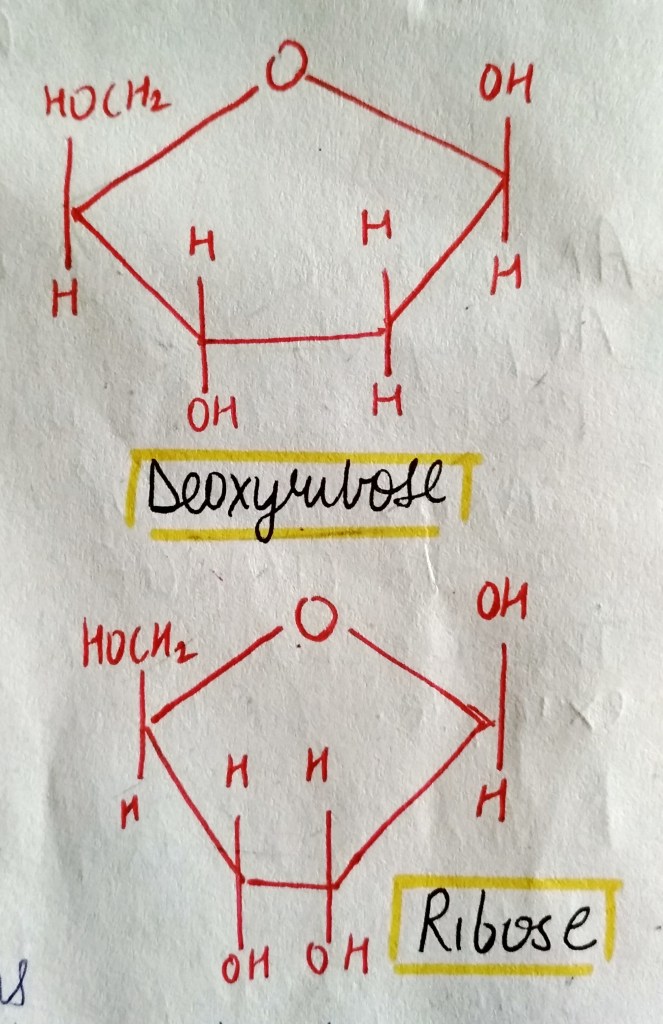
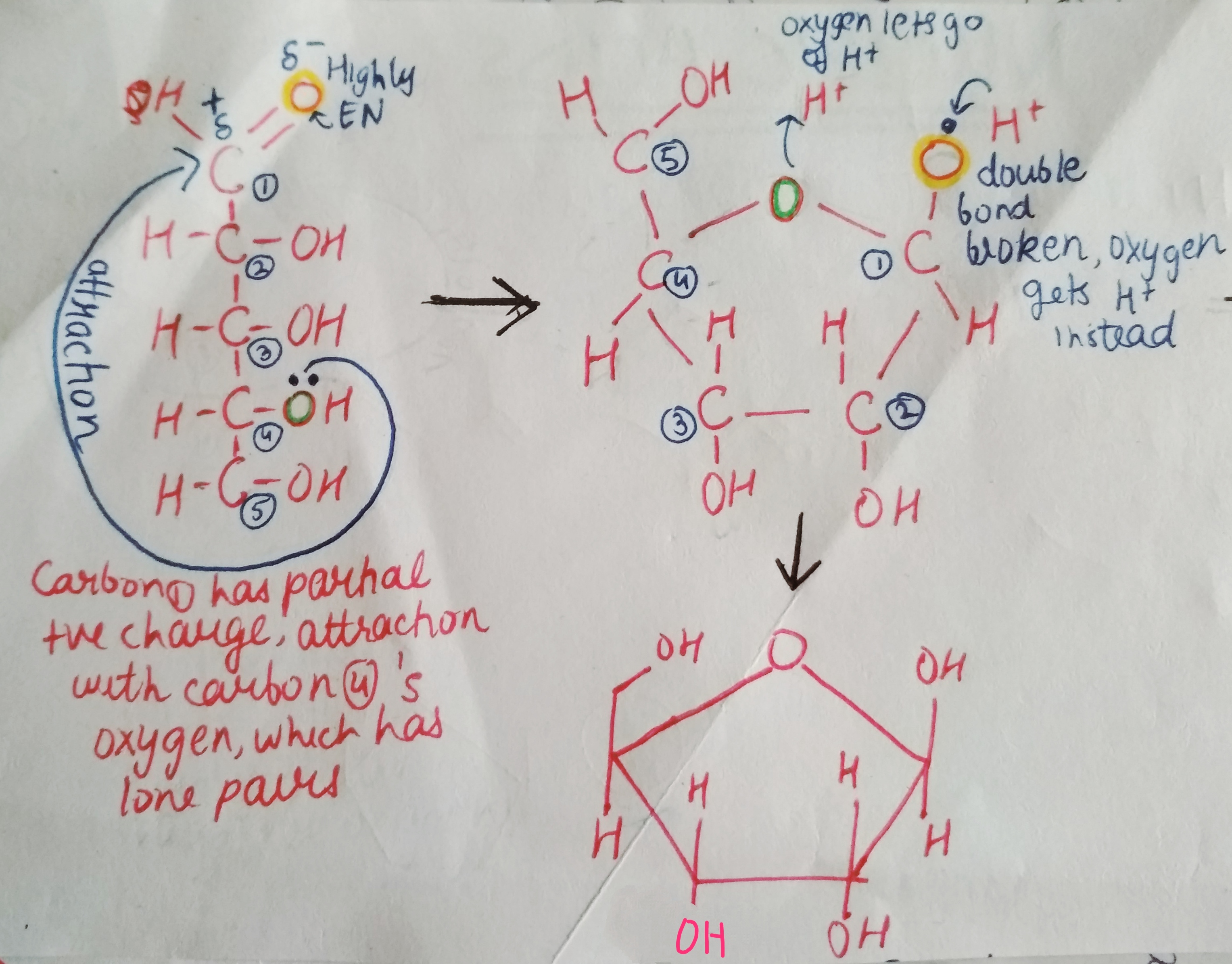
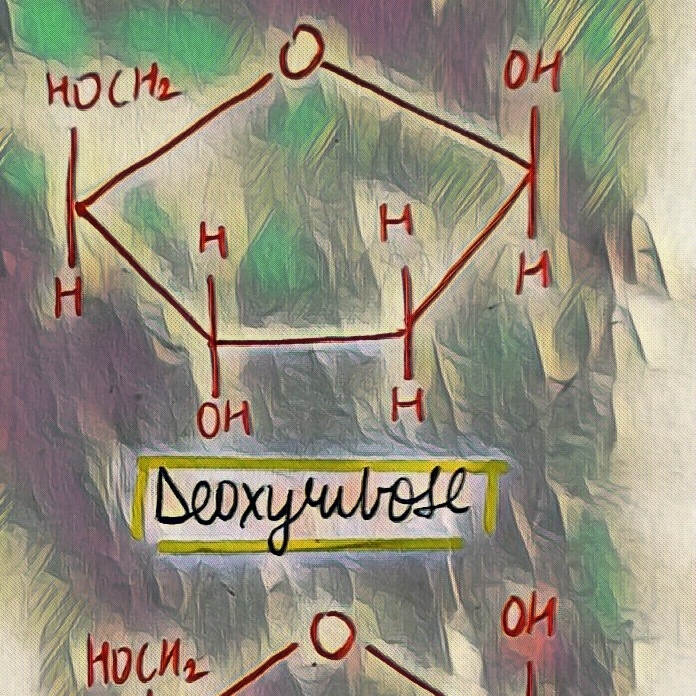
DEOXYRIBOSE and RIBOSE are the sugars found in DNA and RNA respectively. both are almost identical, ALMOST. Their names reveal that Deoxyribose has lesser oxygen atoms than Ribose (duh!). Sugars are found naturally in ring forms and not the simple straight chains, because nature loves being complex. sugar rings made of 5 elements are called “FURANOSE” rings.

Ring formation in ribose

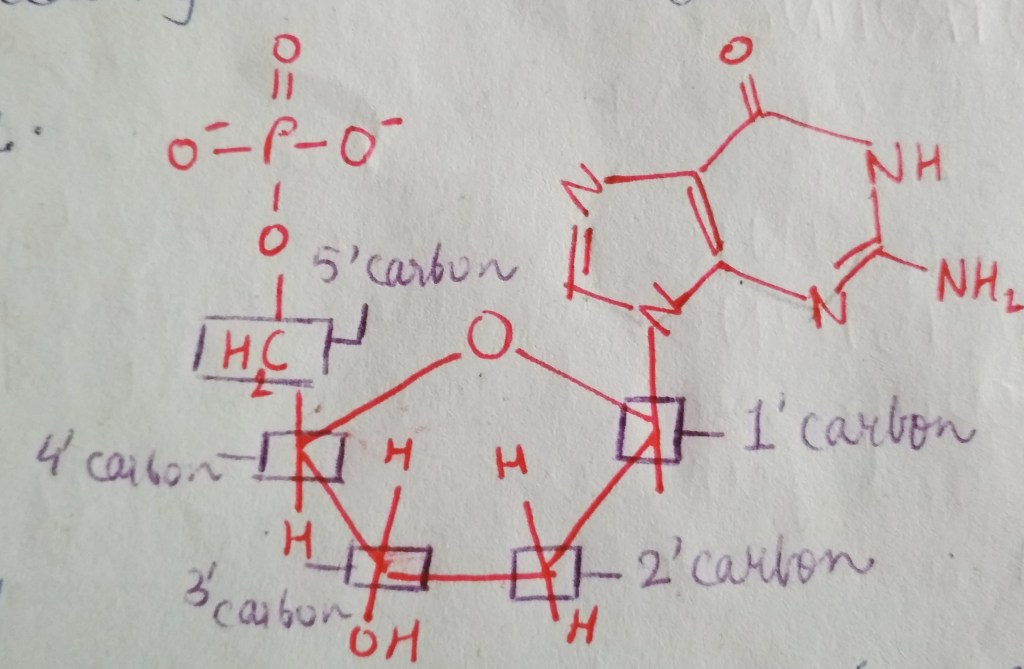
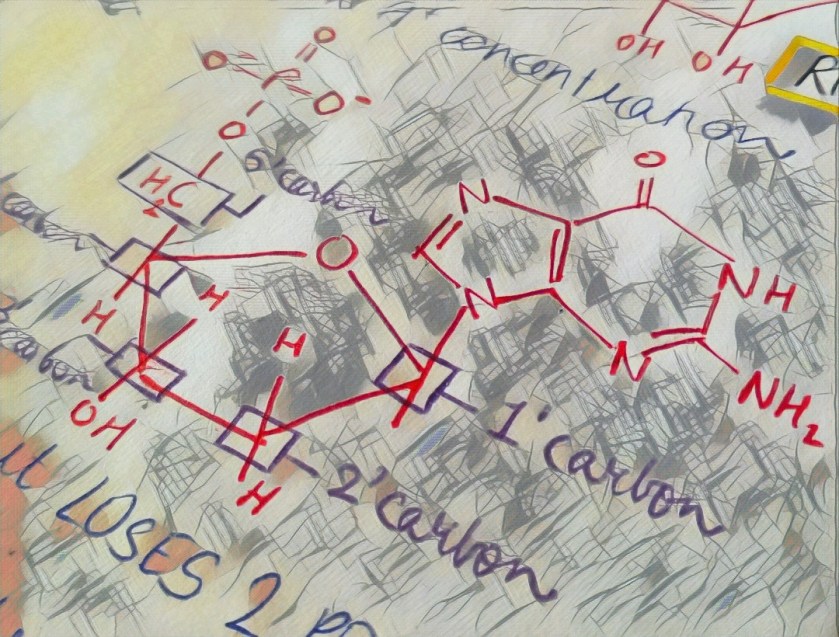
The carbon atoms in them are numbered with a “prime” symbol (‘), since carbons of the nitrogenous bases are numbered normally, and we don’t wanna be confused with our carbons. The N-base is attached to the 1′ and phosphate to the 5’ carbon.

Posted in Uncategorized

The Rungs To Our Ladders

If you were to look at unwound DNA/RNA string, you would know what I mean when I call it a ladder. The steps in between are the BASES. It is weird that despite being named “acids” DNA/RNA have bases in them, but the reason behind their names shall be discussed later.

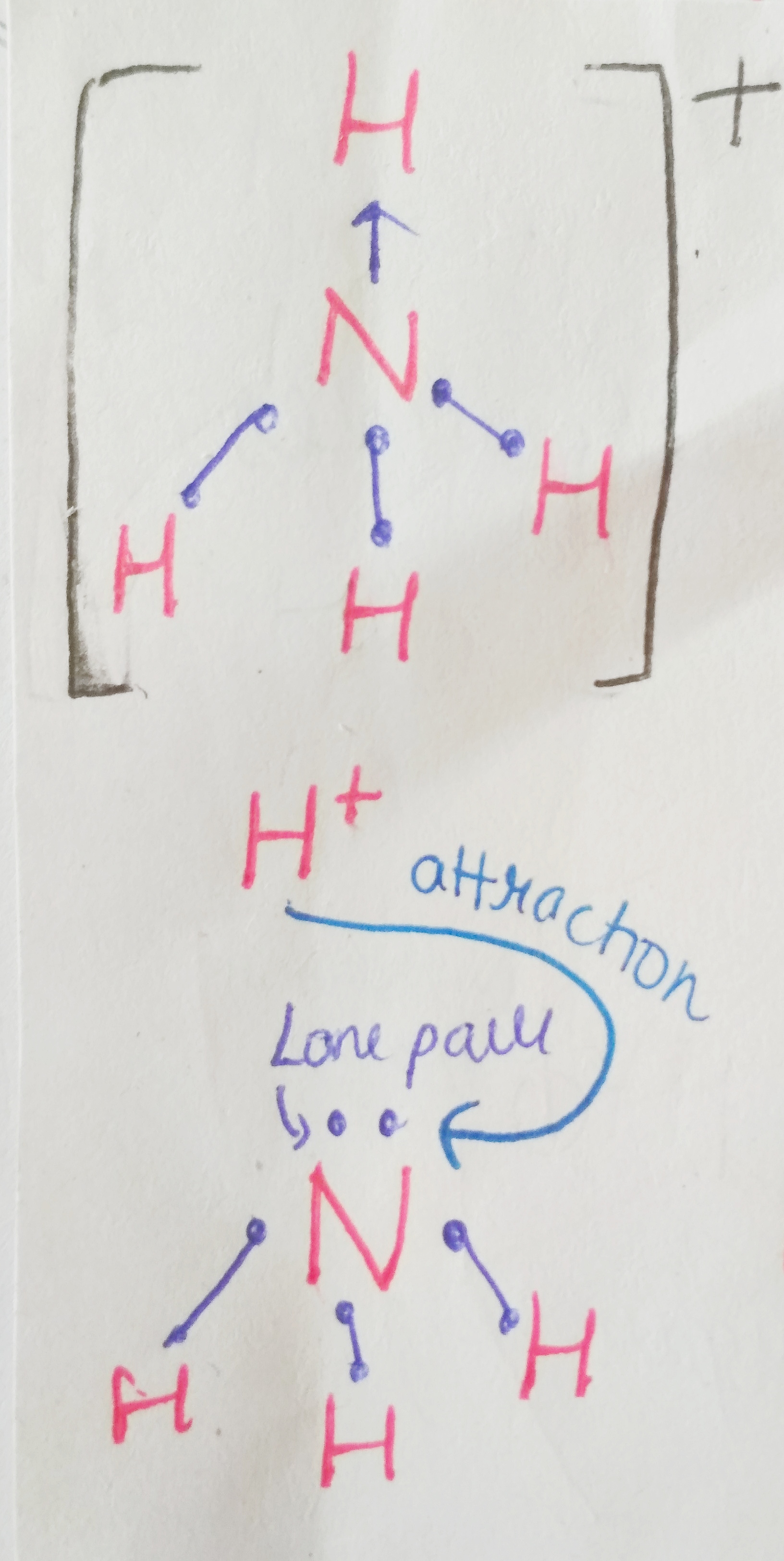
Nitrogenous bases are called so because of the presence of lone pair electrons present on the nitrogen atoms. These electrons are capable of drawing H+ ions towards themselves from aqueous solutions, making them basic. (proton acceptors are bases)

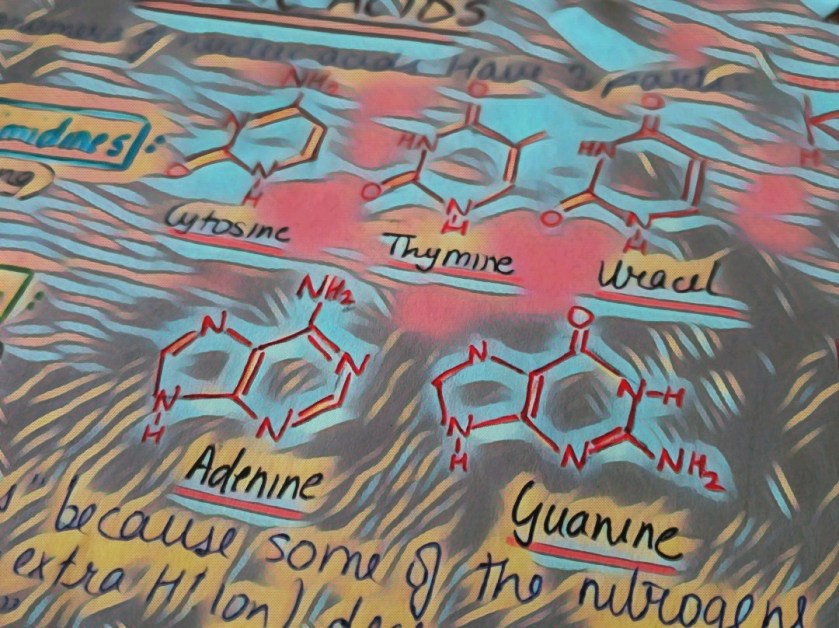
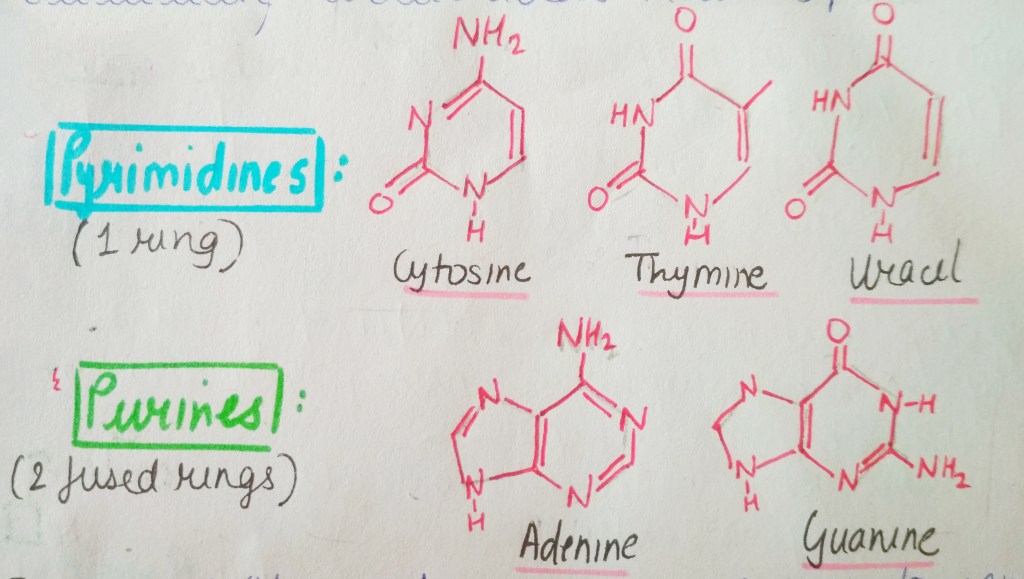
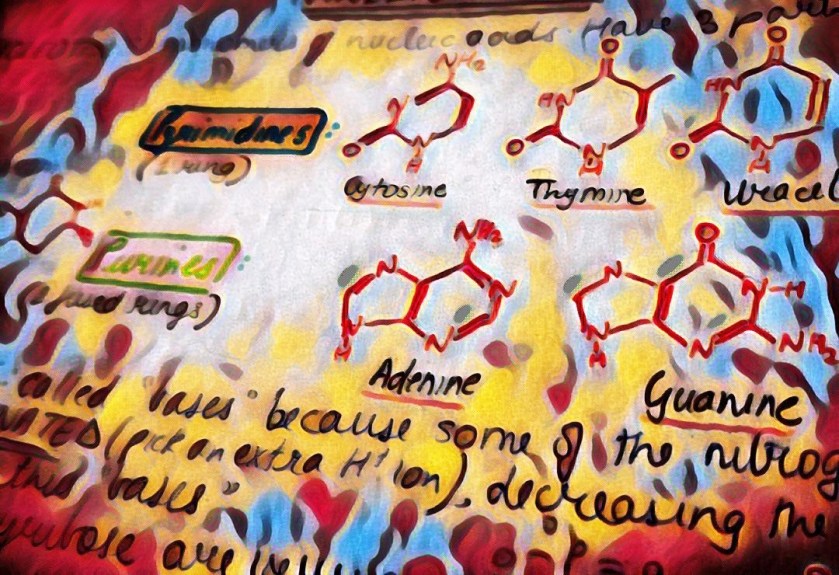
Nucleic acids have 5 different types of N-bases, which are classified into 2 types: Purines and Pyrimidines. Purines have a double-ring structure whereas pyrimidines are known for single ring structures.

Uracil is a nitrogenous base found only in RNA. It forms hydrogen bonds with adenine. Production of uracil takes up lesser energy as compared to thymine, hence it is used in RNA.

When it comes to DNA, thymine is used. The reason behind this might be the need to prevent any kinds of errors and quickly detect mutations and problems in the strand. How? Cytosine, on degrading chemically, forms uracil. Had uracil been a part of DNA, such degradations would have gone unnoticed. Thus thymine is used in DNA, since it is the primary genetic material, and unlike RNA, slight mutations can cause drastic effects on the organism.

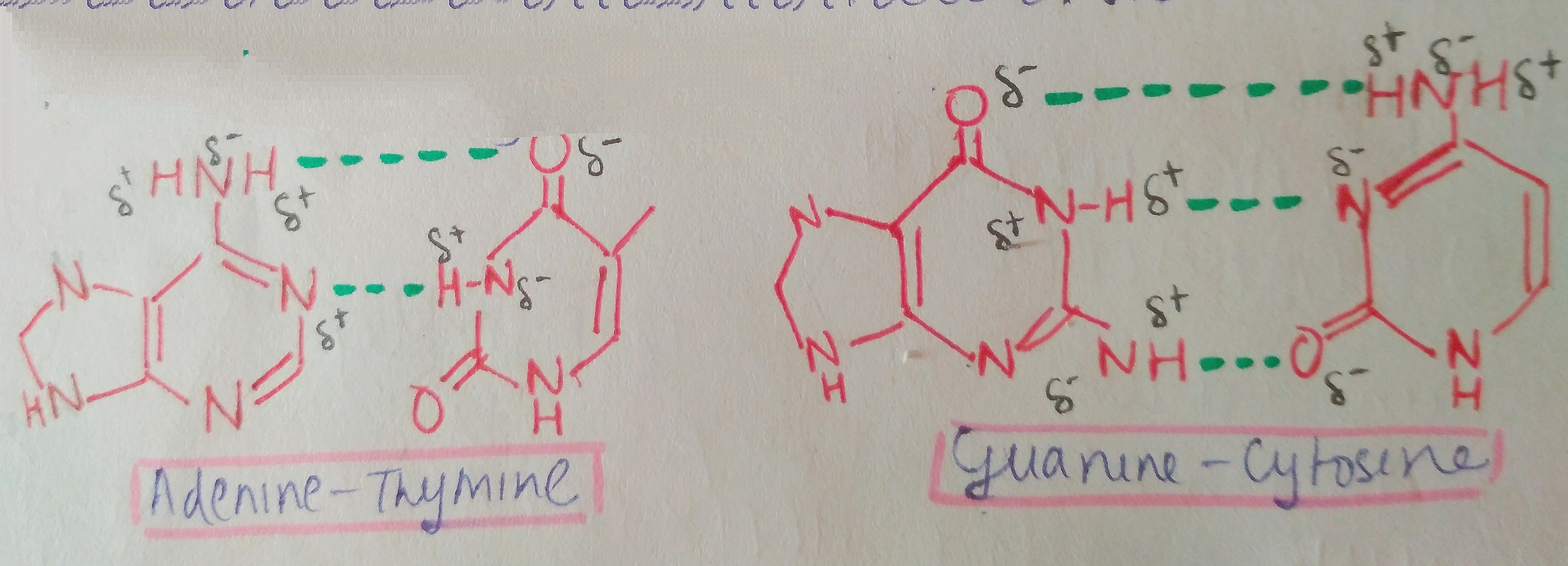
BONDING BETWEEN BASE PAIRS: Bonding between the N-base pairs is done with the help of Hydrogen bonding. There is a development of partial charges due to the electronegativity differences in nitrogen, hydrogen, oxygen and carbon. This leads to attraction between opposite charges and bond formation.

The green dotted line represents the hydrogen bonds

Posted in Uncategorized

The Beaded Necklace

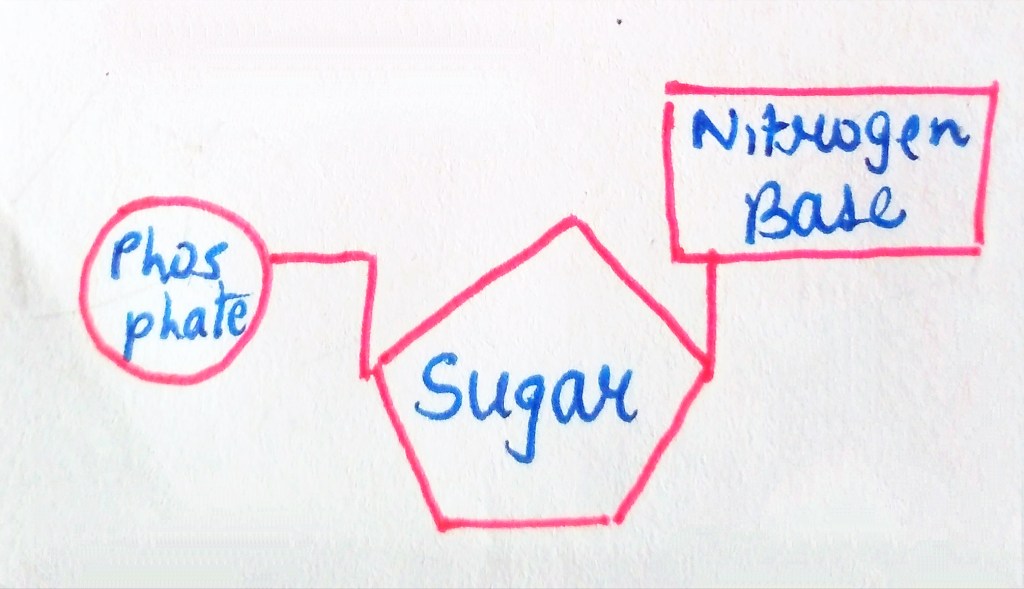
Beaded Necklace is one of my many names for nucleic acids. the reason being that they are made up of tiny sub-units called NUCLEOTIDES. to complicate things further, nucleotides themselves have three parts: NITROGENOUS BASES, SUGAR and PHOSPHATE. we shall cover them in more detail later on!

A very simplified version

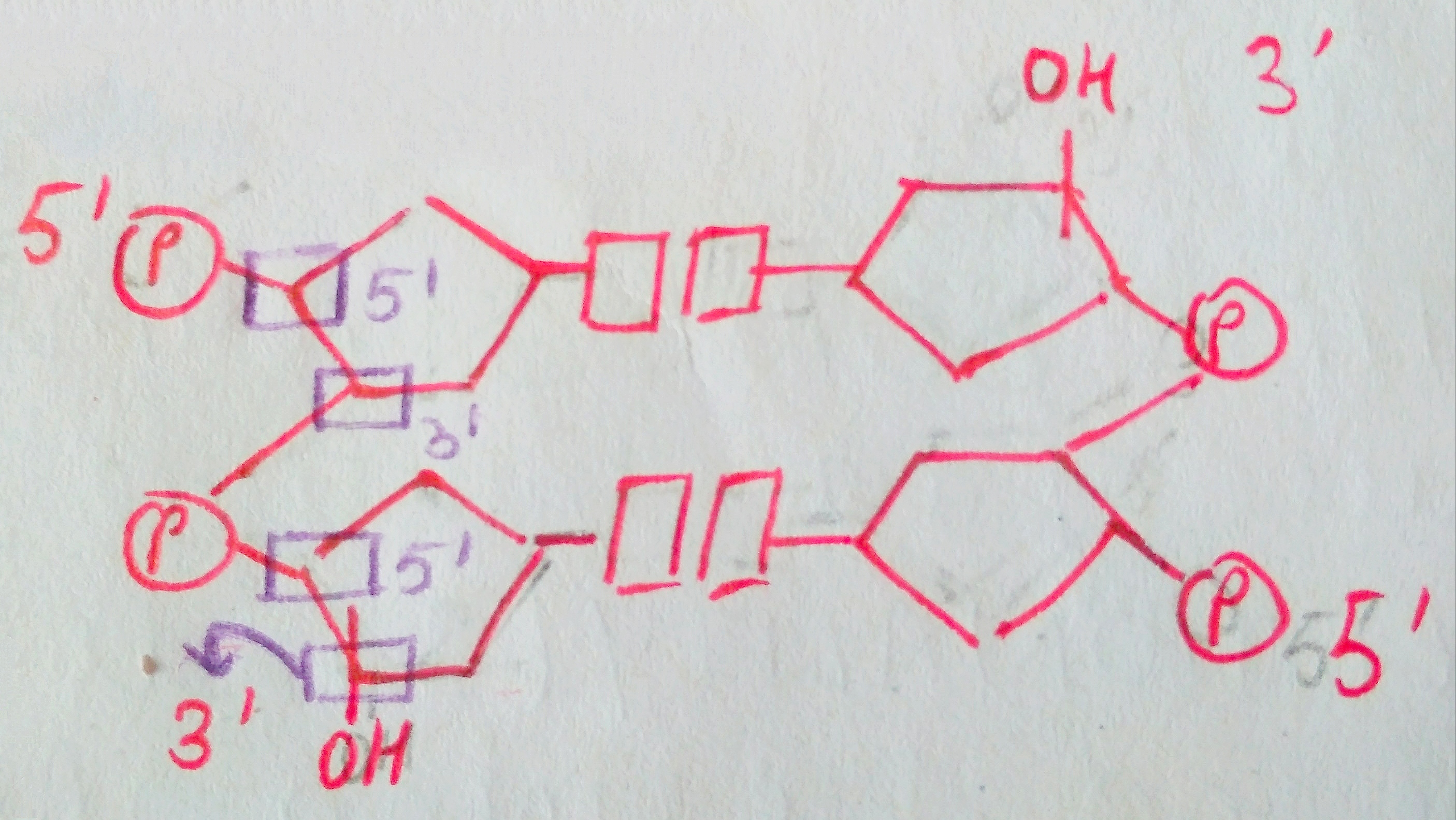
Nucleotides fuse together to form “Polynucleotide Chains” (poly: many), another name for nucleic acids. These chains have “Directionality“, or simply put, the two ends of these chains are different from each other. The ends are numbered as 3′ and 5′. The 3′ end has Hydroxyl group (-OH) of the sugar and 5′ end has the sticking out.

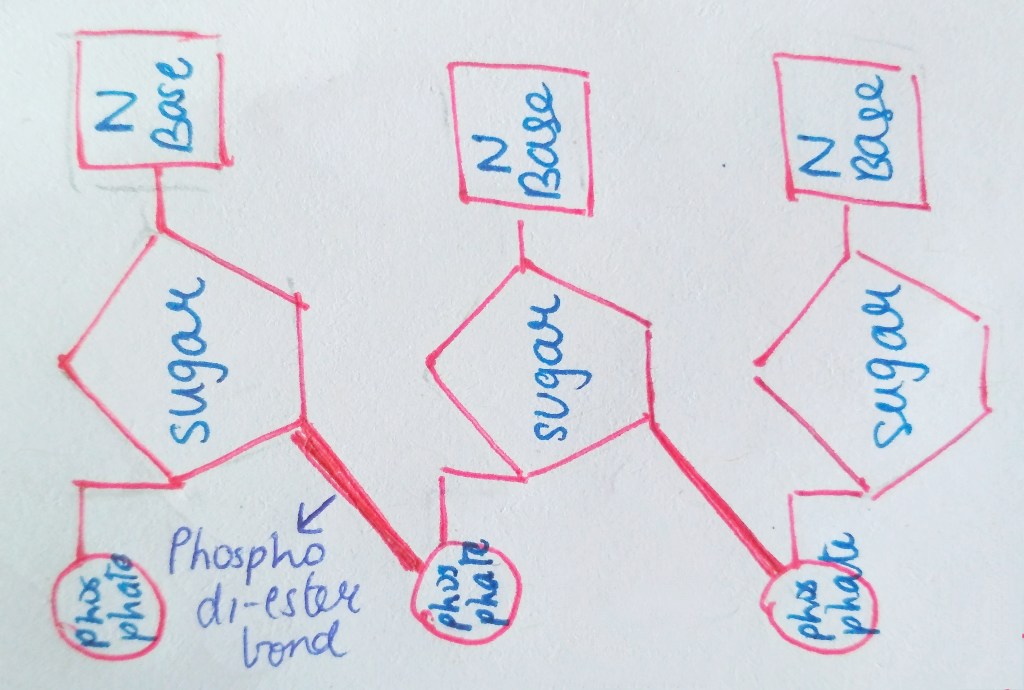
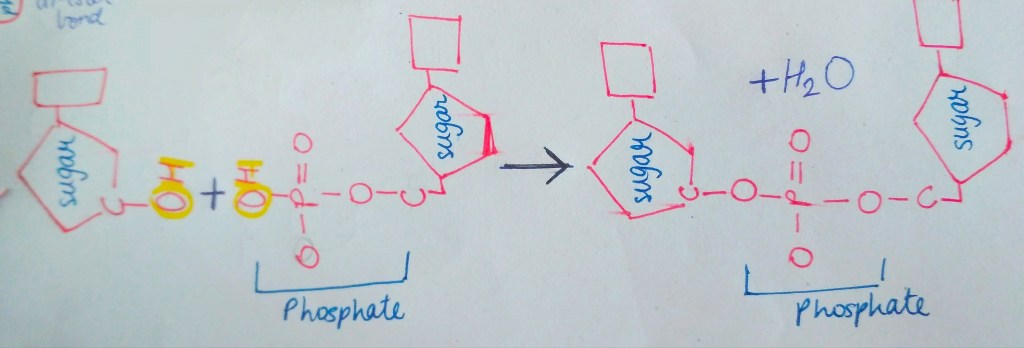
As new nucleotides attach, the OH of chain attaches to the phosphate of incoming nucleotide, hence the chain grows at its 3′ end. The bonds formed are called Phosphodiester Linkage.

Phosphodiester linkage
A slightly complicated version

An ester bond is typically characterized by a carbon bound to three other atoms: a single bond to a carbon, a double bond to an oxygen, and a single bond to an oxygen. Since a phosphorus is present instead of carbon, and the phosphorus has single bonds to 2 oxygens, the name “Phospho-di-ester” (di: two) is used.

Posted in biology, genetics, science

Our True Identity

ACIDS. That’s what defines us. More particularly, Nucleic Acids. When the question arises in our mind, who really we are, we often forget about this incredible string within us that determines everything, our features, figures and all our flaws, be it physical, mental or emotional.

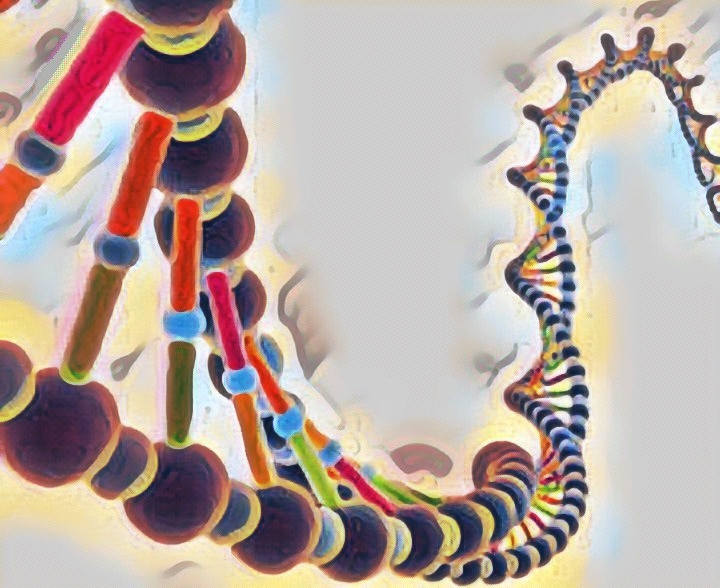
This is what defines us: DNA

It’s strange how these thin microscopic threads within us make us who we are, yet, it is fascinating nonetheless.

I mean yeah, black-holes and supernovas exist, but we shouldn’t forget the tiny miracles within us, which are the foundations of our existence.